
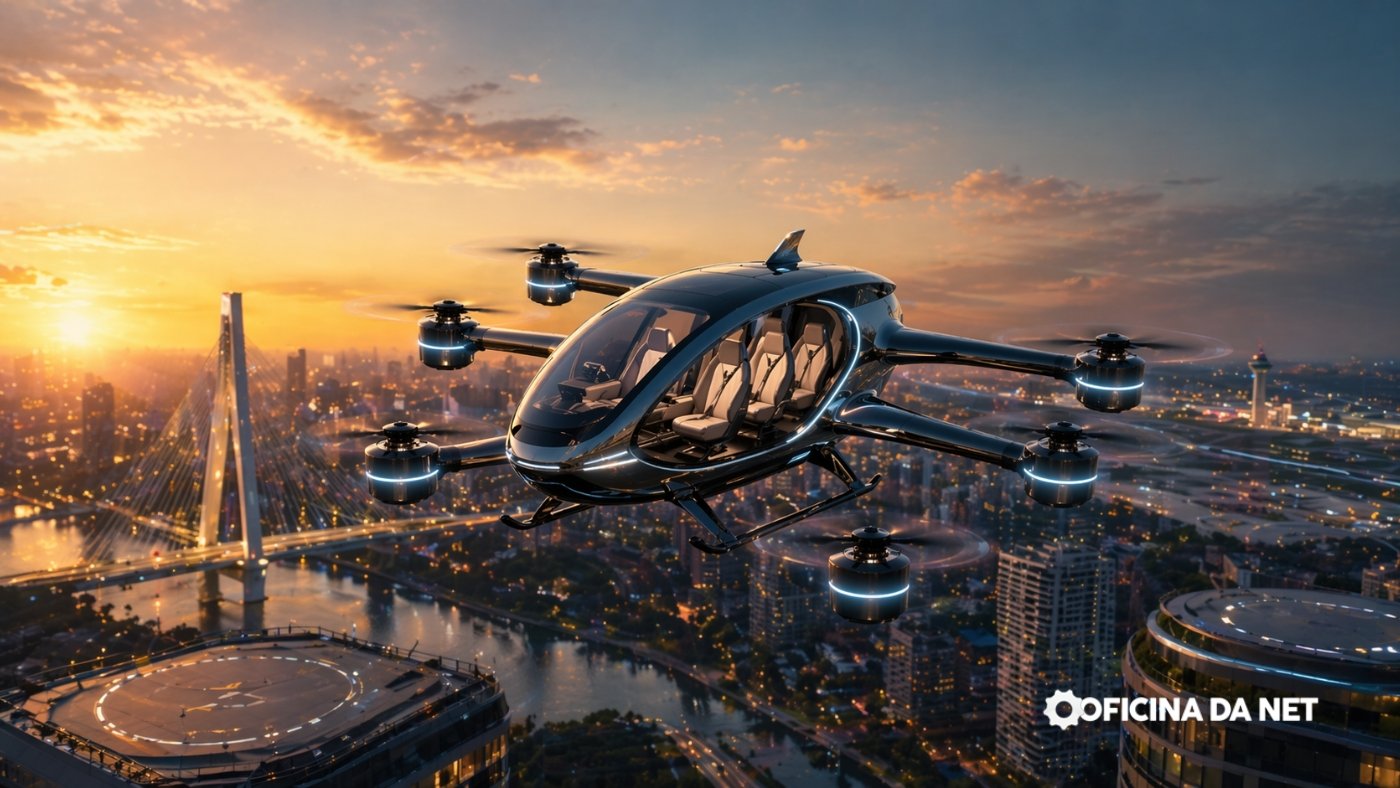

The eVTOL developed by Eve Air Mobility, affiliated with Embraer, has begun flight testing in São Paulo and completed 50 successful flights with its full-scale prototype. Despite its nickname, it is not a typical car that can take off from the street and fly.
The eVTOL is an electric air taxi meant for short trips in busy urban areas like airports, financial districts, events, and high-traffic regions.
Eve stated that the initial flight of the full-scale prototype occurred on December 19, 2025, at the Embraer test facility in Gavião Peixoto, São Paulo. This flight initiated the testing phase and confirmed key aircraft systems including fly-by-wire controls, support rotors, and integrated propulsion.
The project has made progress since that time. In April 2026, Eve revealed that the prototype had conducted 50 test flights, totaling over two hours of flight time and providing data for the upcoming stages of development and certification.
How is Embraer’s air vehicle performing?
Eve eVTOL is an electric aircraft meant for urban air mobility tasks. It features eight rotors, a lift + cruise setup, fixed wings for cruising, and an approximate range of 100 km, as per the manufacturer.

The company anticipates an initial capacity of four passengers and one pilot, with the potential for up to six passengers once pilotless operations are approved.
The main distinction lies in the operational method. Unlike traditional airplanes, eVTOLs can take off and land vertically, eliminating the need for a standard runway. The concept involves utilizing vertiports, which resemble compact terminals for landing and boarding, strategically located throughout urban areas.
The eVTOL should focus on routes with slow, unreliable, or time-consuming ground transportation instead of trying to compete with ride-sharing vehicles. Travel between far-off neighborhoods, airports, and business districts is the most probable application.
São Paulo is considered one of the most promising areas for urban air mobility in Brazil, making it a focal point for discussions on regulation, infrastructure, vertiports, and training related to future eVTOL operations in the country.
The company is also linked to Revo, an urban air mobility operator located in São Paulo. In 2025, Eve revealed a deal with Revo for up to 50 eVTOLs and associated services, suggesting that Brazil could be one of the initial markets for aircraft operation.
Is he able to carry passengers now?
The current flights are part of the prototype testing phase. Eve plans to create six prototypes as part of the certification process in collaboration with ANAC, the Brazilian authority overseeing the process. The company aims for first deliveries and service launch in 2027, pending technical and regulatory developments.
ANAC has released aircraft capability standards for the EVE-10 model, which is a crucial part of the certification process. These standards cover aspects like structure, control systems, propulsion, and battery, ensuring safety before any public use. Consequently, the model is not yet accessible to the public.
What is needed to come true?
In cities such as São Paulo, a comprehensive infrastructure will be essential for the operation of eVTOLs, not just the aircraft itself.
This comprises:
- airplane approval
- Pilot and operation guidelines.
- Vertiports strategically located.
- charging systems for electricity;
- collaboration with air traffic control;
- Urban routes that are secure.
- public approval;
- A workable pricing structure.
eVTOL is expected to initially serve premium routes, similar to helicopters, but with the advantages of quieter operation, electric power, and potential cost savings in the long run.
Is it truly a car that can fly?
The accurate term is eVTOL, but it is commonly referred to as a “flying car” to make it easier for the public to grasp the concept: an electric vehicle that is smaller than a traditional airplane, capable of vertical takeoff and designed to transport individuals within urban areas.
Eve’s eVTOL was designed as an electric aircraft, not for use on roads like a car. Its operation requires aeronautical infrastructure, regulatory approval, and designated flight paths.
The nickname stuck because it effectively captures the idea of the future. For years, flying cars were seen as a sci-fi symbol, but now technology is moving from concept to real-world testing in Brazil.
When will electric vertical takeoff and landing aircraft be able to begin operations?
Eve is projected to begin service in 2027 once all necessary testing and certifications have been completed. In the meantime, the company will focus on expanding the flight test program to assess various factors such as speed, stability, power usage, noise, vibrations, and aircraft performance.
The company announced in April 2026 that tests were progressing for broader evaluations of the flight envelope, with full transitions expected to occur within the year.

